
The Illusion of Availability: Why Property Listings Don’t Reflect Reality
Understanding the Gap Between What You See and What Actually Exists
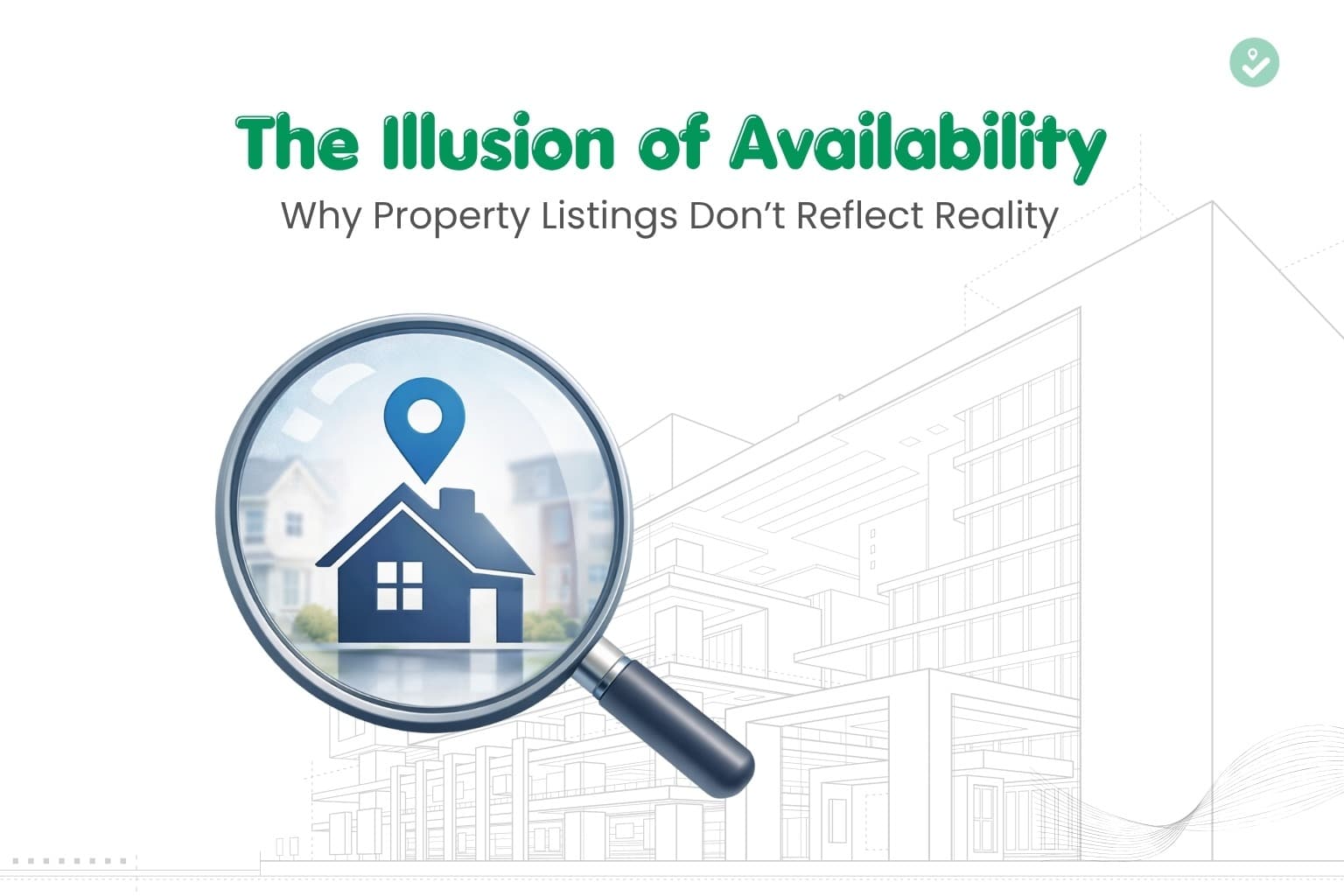
In today’s digital-first real estate market, property discovery begins with listings.
Thousands of options appear instantly - across portals, social platforms, and broker networks - creating a strong perception of abundance and availability.
However, this perception is often misleading.
Behind the volume of listings lies a fundamental disconnect between what is displayed and what is actually available, relevant, or actionable.
This gap is what can be described as the “illusion of availability.”
The Rise of Listing-Driven Real Estate
Over the past decade, real estate has shifted from offline networks to online aggregation. Listings have become the primary unit of visibility.
Multiple platforms host overlapping inventories
The same property is often listed by multiple agents
New listings are added faster than old ones are removed
According to industry observations, a significant portion of listings across platforms are either duplicated, outdated, or no longer actively available at any given time.
👉 This creates a key problem:
More listings do not necessarily mean more real options.
Where the Illusion Begins
1. Duplicate Listings Across Platforms
A single property can appear multiple times:
Listed by different brokers
Reposted with slight variations
Circulated across platforms
This inflates perceived inventory without increasing actual supply.
2. Outdated Availability
In fast-moving markets, properties get sold or rented quickly. However, listings often remain active long after they are no longer available.
Delayed updates
Lack of real-time synchronization
No standardized removal process
As a result, buyers frequently engage with properties that are no longer in the market.
3. Incomplete or Selective Information
Many listings highlight only partial information:
Missing pricing clarity
No real-time status (available / sold / under negotiation)
Limited details on legal or occupancy status
This creates a perception of availability without enabling informed decisions.
4. Visibility Without Relevance
Just because a property is visible does not mean it is relevant.
Budget mismatch
Location misalignment
Incorrect configuration
Buyers are exposed to large volumes of listings, but only a small percentage aligns with their actual intent.
The Data Problem: Volume vs Accuracy
The real estate industry is experiencing a paradox:
More data, but less clarity.
While listing volumes have increased significantly, data accuracy and standardization have not kept pace.
This results in:
Information asymmetry
Decision delays
Reduced trust in platforms
In many cases, buyers spend weeks filtering options that were never viable to begin with.
The Impact on Buyers
Decision Fatigue
An overload of options creates confusion rather than clarity.
Buyers struggle to identify which listings are genuinely worth pursuing.
Loss of Trust
Repeated exposure to unavailable or misleading listings reduces confidence in platforms and intermediaries.
Slower Decision-Making
Instead of accelerating transactions, excess listings often slow down the process due to:
Re-evaluation cycles
Constant comparison
Uncertainty
The Impact on Brokers and Sellers
The illusion of availability affects not just buyers, but also professionals in the ecosystem.
Serious buyers get diluted within large volumes of low-intent interactions
Time is spent managing irrelevant enquiries
Genuine listings struggle to stand out
This leads to inefficiency across the entire transaction cycle.
Why Listings Alone Are No Longer Enough
The traditional model of “more listings = better platform” is becoming outdated.
Modern real estate requires:
Accurate and verified inventory
Real-time availability updates
Contextual relevance based on user intent
Structured information, not just visibility
Without these elements, listings remain informational but not actionable.
Towards a More Reliable System
To bridge this gap, the industry needs to move beyond listing aggregation towards intelligent, structured discovery systems.
This includes:
Standardized data formats
Reduced duplication
Real-time status updates
Better alignment between listings and user intent
The focus must shift from quantity of listings to quality of information.
Conclusion
The perception of abundant property availability is often just that a perception.
In reality, a significant portion of visible listings does not translate into viable opportunities. This creates friction, delays decisions, and reduces overall efficiency in the market.
Understanding the illusion of availability is the first step toward making better, more informed property decisions.
As real estate continues to evolve, the future will not belong to platforms with the most listings but to those that provide the most accurate, relevant, and actionable information.
Recent Posts

Home Loan ke 10 Terms Jo Aapko Samajhni Hi Chahiye - Before You Sign
30 Jun 2026
Location, Location, Location: The 8 Questions to Ask Before Buying in Any Area
24 Jun 2026
2 BHK vs 3 BHK: The Decision Framework Indian Families Keep Getting Wrong
23 Jun 2026

Best Real Estate Investment Cities in India for 2026
28 May 2026

Cost Overruns in Construction: Causes and Solutions
28 Apr 2026