
Geopolitical Risk and Real Estate: Why Investors Become More Selective
Understanding How Global Uncertainty Reshapes Property Investment Decisions
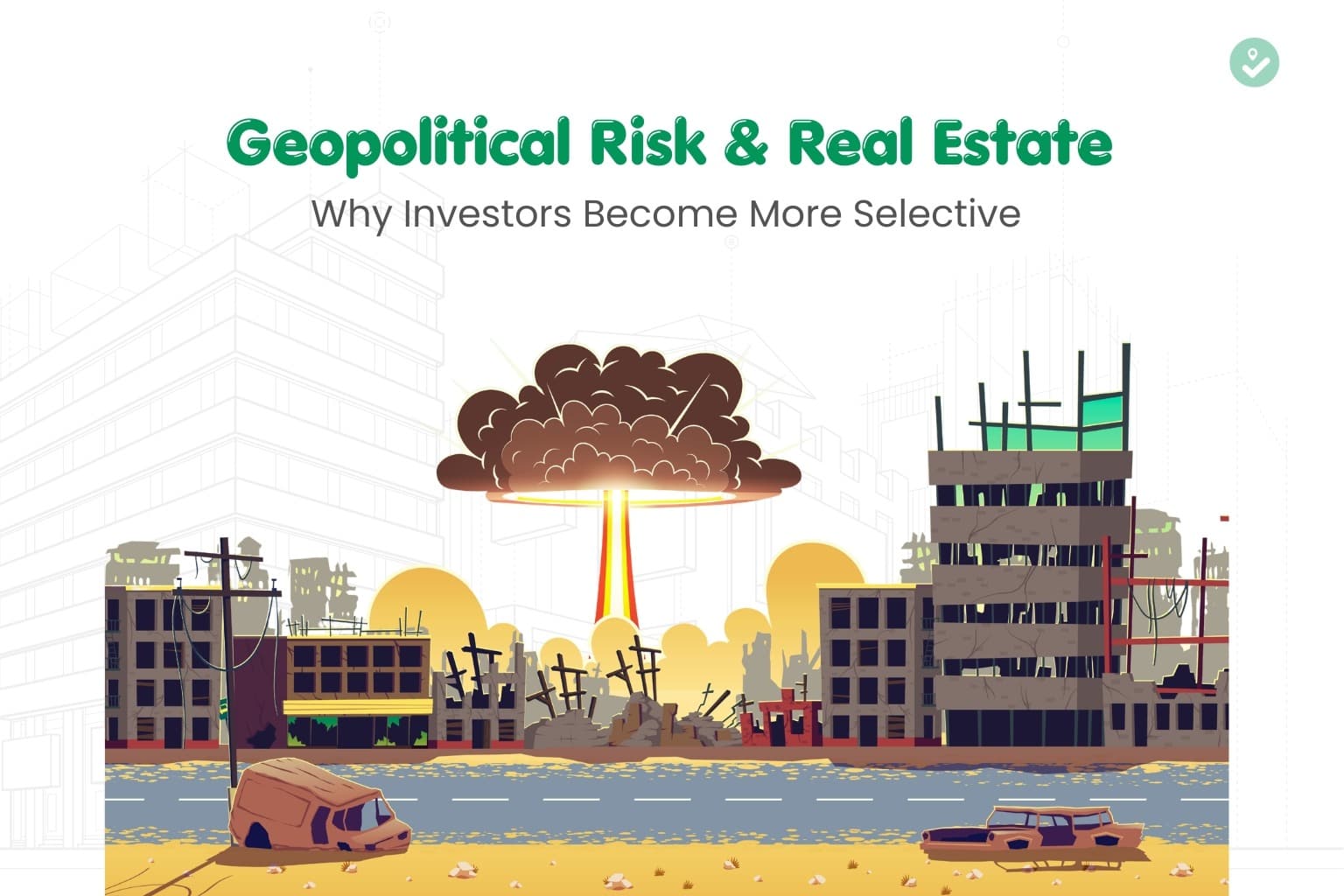
Periods of geopolitical instability rarely halt markets altogether. Instead, they alter behavior.
In real estate, the impact of global conflict is not always immediate or visible. Unlike equities, which react in real time, property markets respond through slower, more structural shifts. The most significant of these shifts is seen in investor decision-making.
In 2026, rising geopolitical tensions - particularly those influencing global energy supply - are not eliminating demand for real estate. They are, however, reshaping how investors evaluate risk, allocate capital, and prioritize assets.
The Economic Transmission: From Conflict to Property Markets
Geopolitical events influence real estate indirectly through a sequence of economic effects:
Conflict → Energy Prices → Inflation → Interest Rates → Investment Behavior
When global tensions disrupt energy supply chains, fuel prices tend to rise. This increase feeds into broader inflation, raising the cost of construction, transportation, and financing.
At the same time, central banks often respond to inflationary pressure by tightening monetary policy, leading to higher interest rates. The result is a more expensive borrowing environment - one that directly affects real estate investment decisions.
Why Investors Become More Selective
1. Rising Cost of Capital
Higher interest rates increase the cost of financing property investments. This reduces leverage-driven expansion and forces investors to be more disciplined in their choices.
As borrowing becomes more expensive, only assets with strong fundamentals - such as reliable rental income or long-term appreciation potential - remain attractive.
2. Increased Market Uncertainty
Geopolitical risk introduces unpredictability across multiple dimensions, including currency movement, material costs, and demand stability.
In such conditions, investors shift away from speculative opportunities and prioritize assets that offer predictability and resilience.
3. Shift from Volume to Quality
In stable environments, investment strategies often focus on scale - multiple deals, faster transactions, and broader exposure.
In contrast, uncertain environments encourage a shift toward quality over quantity:
Prime or well-connected locations
Completed or near-completion assets
Properties with stable occupancy potential
This reflects a more conservative, risk-adjusted approach to investment.
4. Capital Reallocation, Not Withdrawal
Geopolitical stress does not eliminate capital from the market; it redirects it.
Investors tend to move capital toward assets and locations perceived as more stable, transparent, and less volatile. Real estate remains a preferred asset class in such periods but only when it aligns with these criteria.
The Structural Impact on Real Estate Markets
Slower Transaction Cycles
With greater scrutiny applied to each investment, decision timelines tend to extend. Due diligence becomes more detailed, and closure cycles lengthen.
Reduced Speculative Activity
Short-term, high-risk strategies - such as rapid flipping or purely appreciation-driven investments - decline significantly during periods of uncertainty.
Higher Demand for Transparency
As risk perception increases, so does the demand for clarity. Investors seek:
Accurate and verified information
Clear pricing structures
Legal and documentation transparency
This elevates the importance of reliable data and structured processes in real estate transactions.
Real Estate as a Stable but Selective Asset Class
Real estate is often considered a relatively stable asset, particularly when compared to more volatile financial instruments. However, stability alone is no longer sufficient.
In uncertain conditions, the attractiveness of real estate depends on asset-specific strength, not just market trends. Investors are no longer investing broadly - they are investing selectively.
The Evolving Investor Mindset
The modern real estate investor in 2026 is defined by:
A focus on risk-adjusted returns
Greater reliance on data and analysis
Reduced dependence on speculative growth
Increased preference for long-term value creation
This reflects a broader shift from opportunistic investing to strategic investing.
Conclusion
Geopolitical risk does not diminish the relevance of real estate. It refines it.
Periods of global uncertainty act as a filter - removing speculative noise and reinforcing disciplined decision-making. Investors do not exit the market; they adapt to it.
As a result, the real estate landscape becomes more selective, more structured, and ultimately more resilient.
The defining factor in 2026 is no longer the availability of opportunities, but the ability to identify the right ones with clarity and precision.
Recent Posts

Home Loan ke 10 Terms Jo Aapko Samajhni Hi Chahiye - Before You Sign
30 Jun 2026

Location, Location, Location: The 8 Questions to Ask Before Buying in Any Area
24 Jun 2026
2 BHK vs 3 BHK: The Decision Framework Indian Families Keep Getting Wrong
23 Jun 2026

Best Real Estate Investment Cities in India for 2026
28 May 2026

Cost Overruns in Construction: Causes and Solutions
28 Apr 2026